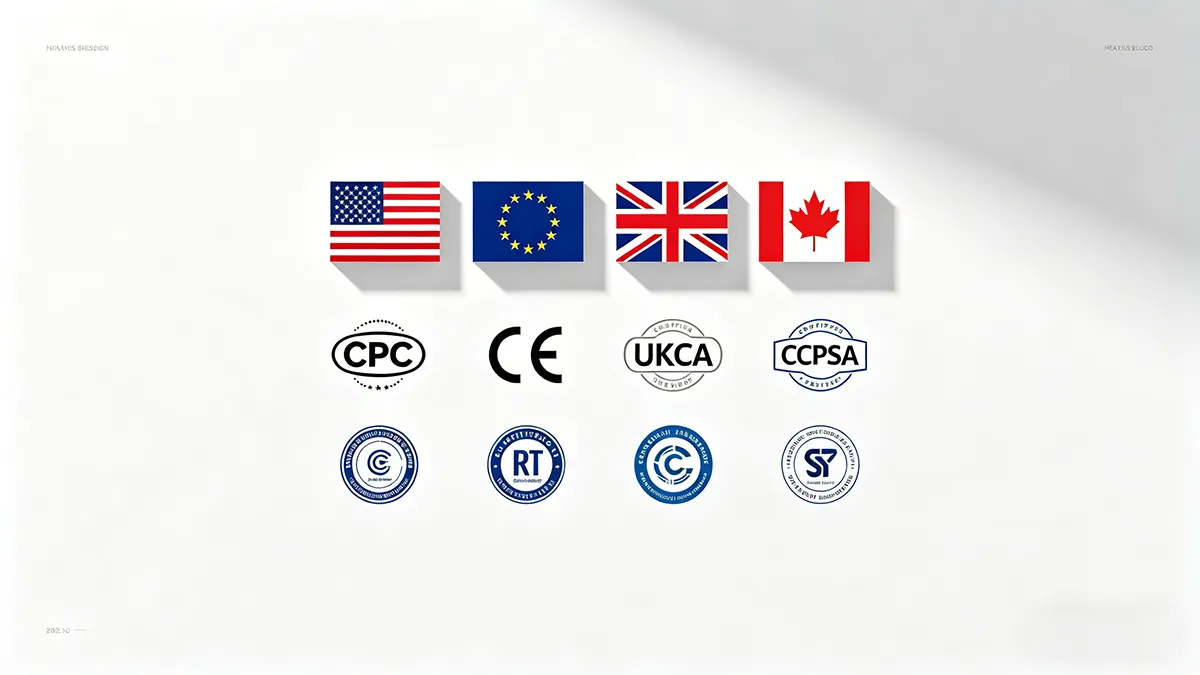
If you’re an importer, retailer, or dropshipper looking to bring gel blasters, water ball blasters, or similar toy guns into international markets, you’ve probably hit a common roadblock: understanding which safety certifications are required for each country. It’s not uncommon to feel overwhelmed by the endless list of acronyms—CPC, ASTM, CE, UKCA—and wondering which ones apply to your business. As someone who’s spent years navigating the global toy import industry, I’m breaking down everything you need to know about gel blaster certifications, so you can avoid costly delays, customs hold-ups, and compliance issues.
First, let’s get on the same page with the products we’re talking about. When I reference gel blasters, I’m including all related variants: water ball blasters, water bead blasters, water bullet toy guns, hydro gel blasters, splatter ball guns, and gel bead toy guns. These products are categorized as toys in most countries, which means they’re subject to strict safety regulations to protect consumers—especially children. The certifications we’ll cover today are non-negotiable for anyone looking to import these products legally, and I’ll map each certificate to the specific countries or regions that require it.
Let’s start with the biggest market for gel blasters: the United States. If you’re importing to the US (or its territories), there are several key certifications you need to have in place before your products even reach customs. Skipping any of these can result in your shipment being seized, fines, or even a ban from selling in the US market.
US Market: The Essential Certifications for Gel Blasters
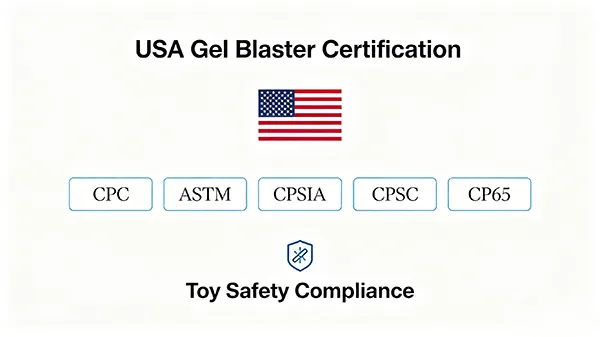
The US has some of the most rigorous toy safety standards in the world, overseen by the Consumer Product Safety Commission (CPSC). For gel blasters, water ball blasters, and any other toy gun variant, here’s what you need:
1. CPC (Children’s Product Certificate)
Let’s start with the basics: the CPC, or Children’s Product Certificate. This is a mandatory document for any toy intended for children under 12 years old—and that includes nearly all gel blasters, since they’re marketed as toys. The CPC is not a “certificate” you get from a third party; instead, it’s a document you (the importer or manufacturer) issue, stating that your product complies with all applicable US safety standards. However, to back up that claim, you need to have your product tested by a CPSC-accepted laboratory.
Why is the CPC non-negotiable? US Customs and Border Protection (CBP) will ask for a valid CPC when your gel blasters arrive. Without it, your shipment will be held, and you’ll face delays while you provide the necessary documentation. For water bullet toy guns and splatter ball guns, the CPC must reference the specific safety standards that apply—which we’ll cover next.
2. ASTM F963
ASTM F963 is the standard that every gel blaster imported to the US must meet. ASTM International (formerly the American Society for Testing and Materials) developed this standard to outline the safety requirements for children’s toys, including physical, mechanical, and chemical safety. For gel blasters, this means testing for things like small parts (to prevent choking), sharp edges, flammability, and the presence of harmful chemicals.
For example, if your water bead blaster has small components (like a detachable scope or small bullets), it must pass the small parts test to ensure it’s safe for children. Hydro gel blasters also need to be tested for chemical safety, as the gel beads themselves must not contain harmful substances. ASTM F963 is often referenced in the CPC, so you can’t have one without the other.
3. CPSIA (Consumer Product Safety Improvement Act)
The CPSIA is a US federal law that was passed to strengthen the safety of children’s products, including gel blasters. It sets strict limits on harmful substances like lead and phthalates, which are often found in plastic toys. For gel blasters and water ball blasters, the CPSIA requires that the product (and its components) contain less than 0.1% lead by weight, and that phthalates (a common plasticizer) are below certain thresholds.
One of the most important things to note about the CPSIA is that it applies to all children’s products, regardless of where they’re manufactured. Even if your gel bead toy gun is made overseas, you (the importer) are responsible for ensuring it complies with the CPSIA. Failure to comply can result in significant fines—up to $100,000 per violation—and even criminal charges in severe cases.
4. CPSC Compliance
The CPSC (Consumer Product Safety Commission) is the government agency that enforces toy safety standards in the US. While the CPSC doesn’t issue certifications directly, it oversees the testing and compliance process. Your gel blaster must be tested by a CPSC-accepted laboratory, and the results must be kept on file for at least 5 years. The CPSC also has the authority to recall products that don’t meet safety standards, so it’s critical to ensure your water ball blaster complies from the start.
5. CP65 (California Proposition 65)
If you’re selling gel blasters in California (the largest state market in the US), you’ll need to comply with Proposition 65 (CP65). This California state law requires businesses to warn consumers about the presence of certain chemicals that are known to cause cancer, birth defects, or other reproductive harm.
For gel blasters, the most common chemicals to watch out for are lead and phthalates. Even if your product meets the CPSIA’s lead limits, it may still need a CP65 warning if it contains any of the chemicals listed under the law. The warning can be on the product packaging or on your website, and it’s a legal requirement for any product sold in California—even if you’re based outside the state.
EU & UK Markets: CE, EN 71, UKCA, and PAHS
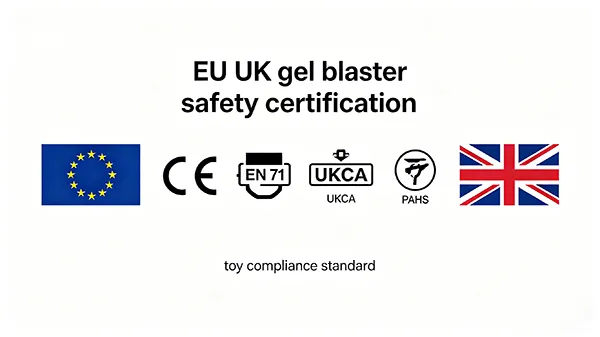
The European Union (EU) and the United Kingdom (UK, post-Brexit) have their own set of safety standards for gel blasters and water ball blasters. If you’re importing to any EU country (Germany, France, Italy, Spain, etc.) or the UK, you’ll need to comply with these certifications to get your products on shelves.
1. CE Marking
The CE mark is a mandatory certification for all toys sold in the EU. It indicates that your gel blaster complies with all applicable EU safety directives, including the Toy Safety Directive (2009/48/EC). To affix the CE mark to your water bead blaster, you need to conduct a conformity assessment, which includes testing the product to relevant standards (like EN 71) and creating a technical file.
The CE mark is not a certification issued by a third party; instead, it’s a self-declaration of compliance. However, you must be able to prove compliance if asked by EU authorities. For gel blasters, the CE mark is required for customs clearance and for selling in any EU member state.
2. EN 71 & BS EN 71
EN 71 is the European standard for toy safety, similar to ASTM F963 in the US. It’s a series of standards that cover different aspects of toy safety, including physical and mechanical properties (EN 71-1), flammability (EN 71-2), and chemical properties (EN 71-3). For gel blasters, EN 71-1 is particularly important, as it tests for small parts, sharp edges, and other physical hazards.
BS EN 71 is the British version of the EN 71 standard. Before Brexit, the UK used the same EN 71 standards as the EU, but now BS EN 71 is the standard for toys sold in the UK. It’s nearly identical to EN 71, but it’s important to ensure your testing is done to the BS EN 71 standard if you’re importing to the UK.
3. UKCA Marking (Post-Brexit)
After the UK left the EU, it introduced its own mandatory marking: the UKCA (UK Conformity Assessed) mark. This replaces the CE mark for products sold in the UK (England, Scotland, Wales, and Northern Ireland). If you’re importing gel blasters to the UK, you need to affix the UKCA mark and ensure your product complies with UK safety standards—including BS EN 71.
It’s important to note that the CE mark is no longer valid for products sold in the UK (unless you’re selling in Northern Ireland, which has special arrangements). So, if you’re targeting both the EU and the UK, you’ll need to comply with both CE and UKCA requirements.
4. PAHS (Polycyclic Aromatic Hydrocarbons)
PAHS are a group of harmful chemicals that can be found in plastic, rubber, and other materials used in gel blasters. The EU has strict limits on PAHS in toys, and many EU countries (like Germany) have their own additional requirements. PAHS testing is often part of the chemical safety testing required for CE marking, and it’s essential for ensuring your water ball blaster is safe for consumers.
For example, Germany’s GS (Geprüfte Sicherheit) mark requires PAHS testing, and many retailers in the EU will ask for PAHS test reports before stocking your gel blaster. Even if you’re not targeting Germany specifically, PAHS compliance is a good practice for the entire EU market.
Canada Market: CCPSA (Consumer Product Safety Act)
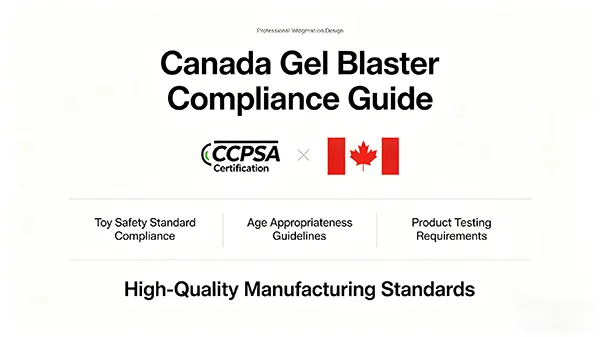
Canada is another major market for gel blasters, and it has its own mandatory safety certification: the CCPSA (Consumer Product Safety Act). This law regulates the safety of consumer products sold in Canada, including toys like gel blasters, water bullet toy guns, and splatter ball guns.
The CCPSA requires that all toys sold in Canada meet certain safety standards, including limits on harmful substances (like lead and phthalates) and physical safety requirements (like small parts testing). Unlike the US CPC, the CCPSA doesn’t require a specific certificate, but you must be able to prove that your product complies with the law. This usually involves having your gel blaster tested by a recognized laboratory and keeping test reports on file.
If you’re importing to Canada, it’s also important to note that the country has strict labeling requirements. Your gel blaster packaging must include information like the manufacturer’s name and address, the product name, and any safety warnings (like “not for children under 3 years old” if the product has small parts).
Common Mistakes to Avoid When Importing Gel Blasters
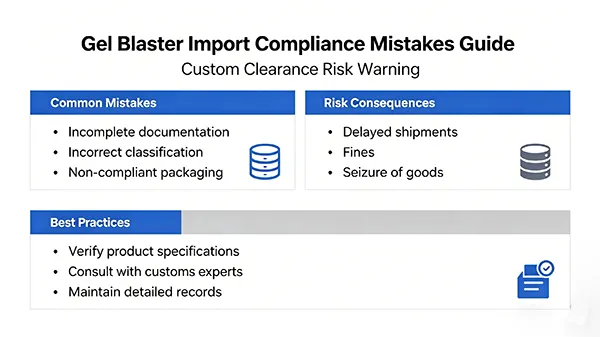
Now that we’ve covered the key certifications, let’s talk about some common mistakes I see importers make. These mistakes can cost you time, money, and even your business, so it’s important to avoid them:
Mistake 1: Assuming One Certification Works for All Markets
This is the biggest mistake I see. A CPC certificate for the US won’t work for the EU, and a CE mark won’t work for the UK. Each market has its own unique requirements, so you need to get the right certifications for each country you’re targeting. For example, if you’re importing to both the US and the EU, you’ll need CPC, ASTM, CPSIA for the US, and CE, EN 71 for the EU.
Mistake 2: Skipping Third-Party Testing
Many importers try to cut corners by skipping third-party testing and issuing a CPC or CE mark without any evidence of compliance. This is risky—customs authorities and regulatory agencies (like the CPSC or EU’s RAPEX) can request test reports at any time. If you can’t provide them, your shipment will be seized, and you’ll face fines.
Mistake 3: Ignoring Regional Requirements (Like CP65)
Even if you have the main certifications for a country, you might be missing regional requirements. For example, in the US, California’s CP65 is a state-level requirement that’s easy to overlook, but it’s mandatory if you’re selling in California. Similarly, in the EU, Germany has stricter PAHS requirements than other member states.
Mistake 4: Using Outdated Certifications
Safety standards and certifications are updated regularly. For example, ASTM F963 is updated every few years, and the CPSIA has been amended several times since it was passed. Make sure your certifications are up-to-date with the latest standards—using an outdated certificate is the same as having no certificate at all.
Final Thoughts: How to Ensure Compliance
Importing gel blasters, water ball blasters, or any other toy gun into global markets doesn’t have to be overwhelming. The key is to do your research, get the right certifications for each market, and work with a reliable manufacturer or supplier who can provide the necessary test reports and documentation.
To recap, here’s a quick reference guide for which certifications you need for each market:
US & California: CPC, ASTM F963, CPSIA, CPSC, CP65
EU: CE, EN 71, PAHS
UK: UKCA, BS EN 71, PAHS
Canada: CCPSA
Remember, compliance isn’t just a legal requirement—it’s also a way to build trust with your customers. When you can show that your gel blaster, water bead blaster, or splatter ball gun is safe and certified, you’ll stand out from competitors who cut corners. And if you’re ever unsure about which certifications you need, don’t hesitate to consult a compliance expert or a trusted laboratory.
I hope this guide has helped clarify the certification process for importing gel blasters. If you have any questions—whether it’s about a specific certificate, testing requirements, or market-specific rules—feel free to leave a comment below. Happy importing!